Professor, Physiology and Biophysics in Systems and Computational Biomedicine Associate Dean, Weill Cornell Graduate School
Our lab studies fibrosis, specifically the interactions between mast cells and fibroblasts; mast cells reside in close proximity to fibroblasts. Our goals are identifying new anti-fibrotic targets and designing novel therapeutic compounds to prevent fibrosis.
The goal of the Silver Laboratory is to define the mechanisms by which fibrosis occurs. Fibrosis impacts a significant portion of the global population and is a growing public health concern. A hallmark of fibrosis is the increased expression of fibroblast transforming growth factor-β (TGF-β) and the subsequent activation of collagen genes. Large-scale clinical studies of pharmacologic therapy for inhibiting organ fibrosis have predominantly focused on TGF-β and associated signaling pathways involved in the translation of collagenous peptides. However, due to its multi-functionality, targeting TGF- β signaling has a higher likelihood of adverse effects. Plus, TGF- β is not the only pathway contributing to fibrosis. Not surprisingly then, the preponderance of clinical trial evidence suggests that TGF- β-targeted therapies are only partially beneficial, often with poor tolerability. There is a great need for a deeper understanding of the cellular and molecular mechanisms underlying pathological fibrosis and new therapeutic approaches.
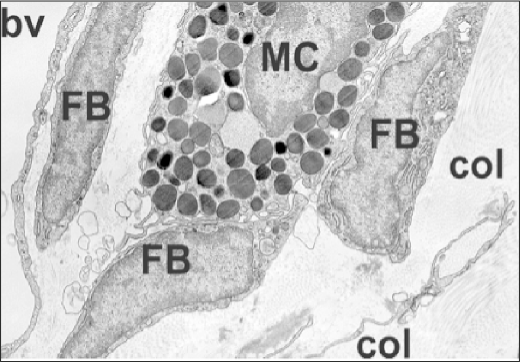
The lab’s research focuses on the interactions between mast cells and fibroblasts, the cells responsible for fibrosis. (Figure 1. see electron micrograph showing spatial relationship between mast cell and fibroblasts). Theassociation between mast cells and fibroblasts has long been appreciated but the cross-talk and mechanistic interactions between. n them are not well defined. We use parallel in vivo and in vitro functional, biochemical, and cell biological approaches to analyze how mast cells and fibroblasts interact to promote fibrosis.The Silver lab has identified numerous pro-fibrotic chemicals and vesicles (exosomes) that are released from mast cells that stimulate fibroblasts and fibrosis. Silver’s studies have identified new therapeutic targets for abating fibrosis. Building on our findings we are utilizing in silico drug design to inform novel anti-fibrotic therapeutics.
Figure 1.
Electron micrograph of mast cell (MC) in close proximity to fibroblasts (FB). Blood vessel, (bv); collagen, (col). Magnification, 7,500x. (R. Mora – Silver Lab)
Biography
Silver completed her undergraduate training at Skidmore College, attended Cambridge University (zoology) as a research assistant (Hal Whitehead), and pursued her graduate work at Brown University, where she earned a doctorate in biology (department of physiology and biophysics) in the laboratory of Don Jackson. She carried out her postdoctoral work in the lab of Lawrence Palmer at Weill Cornell Medical College, department of systems and computational biomedicine (formerly department of physiology and biophysics), where she continued on her academic path to Professor. Silver is also Associate Dean, Weill Cornell Graduate School.
Distinctions:
The Hartwell Foundation Collaborative Research Award
Poisner Lectureship, University of Kansas Medical Center
Cozzarelli Prize, PNAS/NAS
Select Study Prize, American Physiological Society
Council Officer and Treasurer (elected), the Harvey Society
Interim Chair, Department of Systems and Computational Biomedicine
Selected Publications:
Silver, R.B., Reid, A.C., Mackins, C.J., Askwith, T., Schaefer, U., Herzlinger, D., and Levi, R. Mast cells: a unique source of renin. Proc Natl Acad Sci USA. 2004; 101(37): 13607-12. Highlighted in: Molecular Interventions 5(1): 11-13(2005); Science, 317:616 (2007)
Veerappan, A, Thompson, Savage, A, Silverman,M, Chan, ML, Sung, MS, Summers, B, Montelione, KC, Benedict, P, Groh, B, Vicencio, A, Peinado, H, Worgall, S, and Silver, R.B., (2016). Mast cells and exosomes in hyperoxia induced neonatal lung disease. American Journal of Physiology - Lung Cellular and Molecular Physiology Published 8 June 2016 Vol. 310 no. 11, L1218-L1232 DOI: 10.1152/ajplung.00299.2015. Select Recognition Award for Distinction in Scholarship, The American Physiological Society, 2016
Hoppe G, Yoon S, Gopalan B, Savage AR, Brown RM, Case KM, Vasanji A, Chan ER, Silver, R.B., and Sears JE (2016). Comparative systems pharmacology of HIF stabilization in the prevention of retinopathy of prematurity. Proc Natl Acad Sci USA. 2016; Vol. 113, Number 18, E2516–E2525. PMID: 27091985. Highlighted in: Editors' Choice Pharmacology Sci. Signal. 9, (427):ec108 (2016) Recipient of Cozzarelli Award from the National Academies