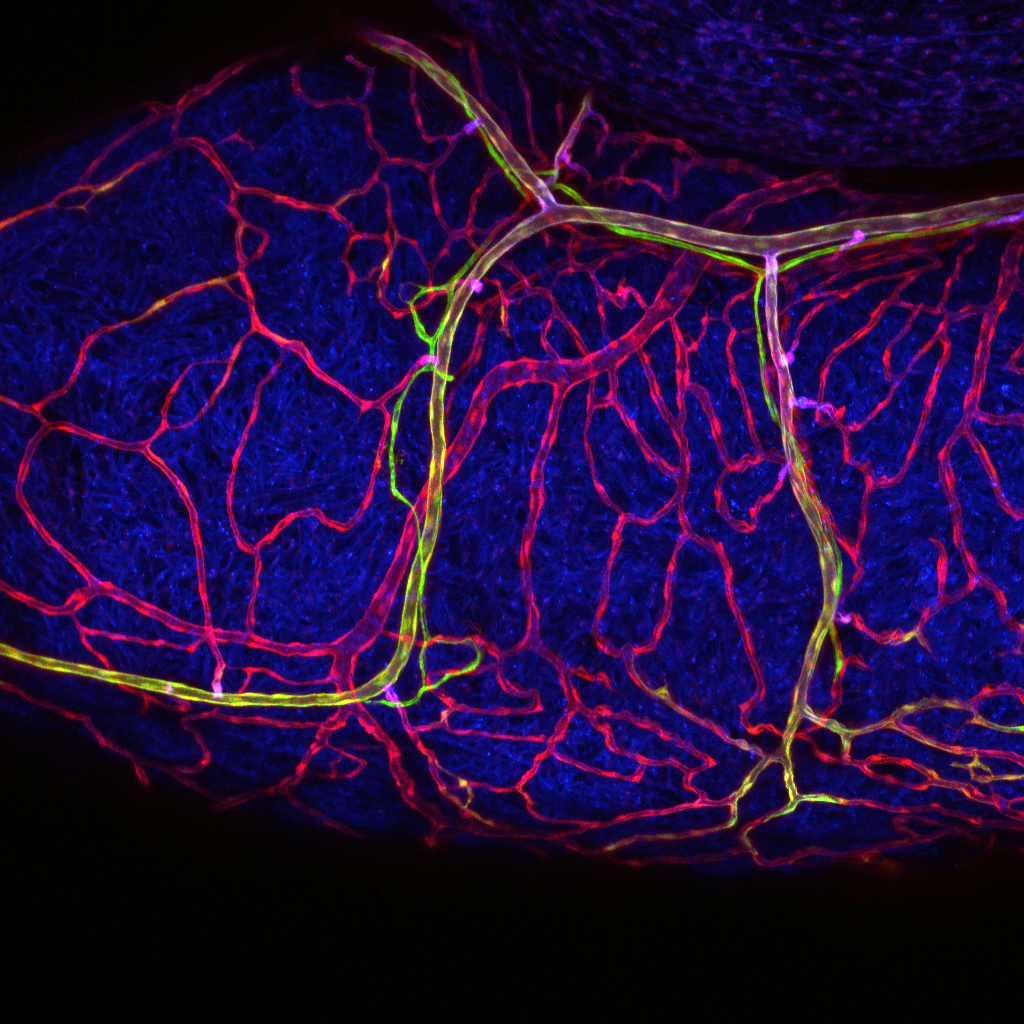
1). Coronary Vessel Development: Chemokine regulation of zebrafish coronary vasculature development
2). Lymphatic Vessels and Inflammation: Development of the lymphatic system and its role in heart and brain regeneration
3). Coronary Vessel Regeneration: Imagining Revascularization after injury
The human heart pumps 5 to 7 liters of blood around the body every minute, 20% of which serves the brain. Both require their own specialized blood and lymphatic vascular systems to meet their physiological demands. The overarching goal of our lab is to determine how blood and lymphatic vasculature develops and how it regenerates while supporting the wider regeneration of functional tissue after injury. We are particularly interested in their roles in promoting natural regenerative responses of heart and brain tissue. We primarily use the zebrafish as a discovery model, taking advantage of its ease of genetic manipulation, imaging and its ability to regenerate functional cardiac and neural tissue after injury. Advancing our understanding of the factors that drive vasculature formation and its roles supporting tissue repair will highlight new therapeutic concepts in regenerative medicine. The study of regeneration in zebrafish can identify pathways that can ultimately be utilized to accelerate regeneration of damaged human tissue.
Figure 1
Figure 2
Biography
Michael Harrison earned his bachelor’s degree in Genetics from Edinburgh University in 2005 and his Ph.D. degree in Developmental Genetics from University of Sheffield, under the mentorship of Vincent Cunliffe. Harrison joined the Saban Research Institute of Children’s Hospital Los Angeles in 2010 as a CIRM Fellow. In 2020, he was appointed Assistant Professor of Cell and Developmental Biology at Weill Cornell Medicine.