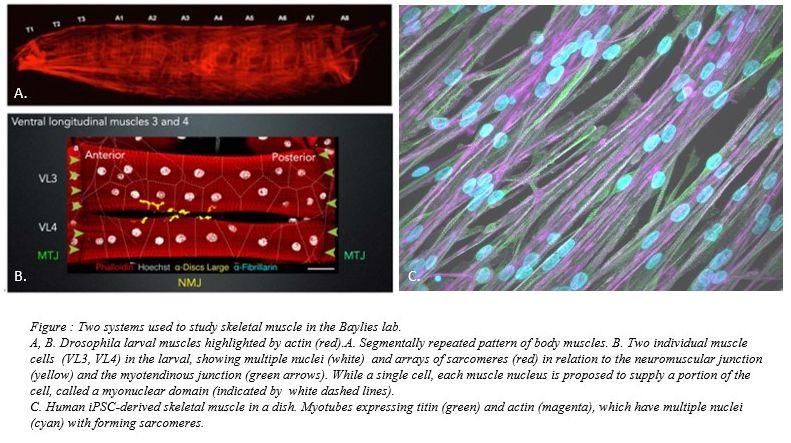
Skeletal muscles come in a variety of shapes and sizes, each tuned to a particular function. Individual muscles also have different susceptibilities to diseases. Therapies that repair muscle wasting due to aging or diseases, like myopathies or cancer cachexia, require the ability to generate specific muscle types of a particular size and shape. Therefore, identifying the mechanisms that guide muscle differentiation, muscle growth, and response to disease/aging are critical. As such, my lab focuses on the following questions:
How are cells specified and differentiate into a mature functional muscle?
How do mature muscle cells respond to growth cues? to exercise?
How do muscle cells respond and change during situations of muscle wasting, such cancer cachexia, muscle myopathies, and aging? With this information, can we design rational therapies to block and/or reverse muscle wasting?
We use two related models to investigate these questions: the fruit fly, Drosophila melanogaster, and more recently, human Pluripotent Stems Cells that we differentiate into skeletal muscles in 2D and 3D. We employ genetics, molecular and cell biological approaches, bulk and single nuclear RNA sequencing and other ‘omics approaches (ATAC, ChipSeq), in vivo time-lapse imaging, confocal and super resolution microscopy, mathematical modeling with our collaborator Dr. Alex Mogilner (Courant Institute, NYU), and biochemistry to identify and characterize genes required for muscle formation, use, and maintenance.
Current Projects:
Mechanisms controlling Skeletal Muscle Size
Regulation of Nuclear Dynamics during Muscle Development, Homeostasis, and Atrophy
Impact of Aging and Cancer Cachexia on the Skeletal Muscle Microenvironment
Maturation and Aging of human IPSC-derived skeletal muscle
Disease modeling in human IPSC-derived skeletal muscle.
Biography
Dr. Baylies earned her A.B. at Dartmouth College and her Ph.D. at Rockefeller University in 1991 where she investigated molecular mechanisms underpinning circadian rhythms that contributed to Dr. Michael Young’s Nobel Prize in 2017. She completed her postdoctoral work with a NATO-NSF fellowship at the University of Cambridge with Dr. Michael Bate. There, her interest in muscle development bloomed, particularly with a view to understanding the intrinsic and extrinsic programs necessary to build a muscle cell. In 1997, Dr. Baylies joined the faculty at Sloan Kettering Institute, as a recipient of the Adler Chair for Junior Faculty, to pursue studies identifying the mechanism required in making muscle fibers with a particular size, shape, and function.
Distinctions:
2022 David P. Hajjar Excellence in Teaching and Mentoring Award
2017 Weill Cornell Medicine Graduate School of Medical Sciences Excellence in Teaching and Mentoring Award
2017- 2022 Co-Director of BCMB Graduate Program
Present Co-Editor of Wolpert’s Principles of Development Textbook