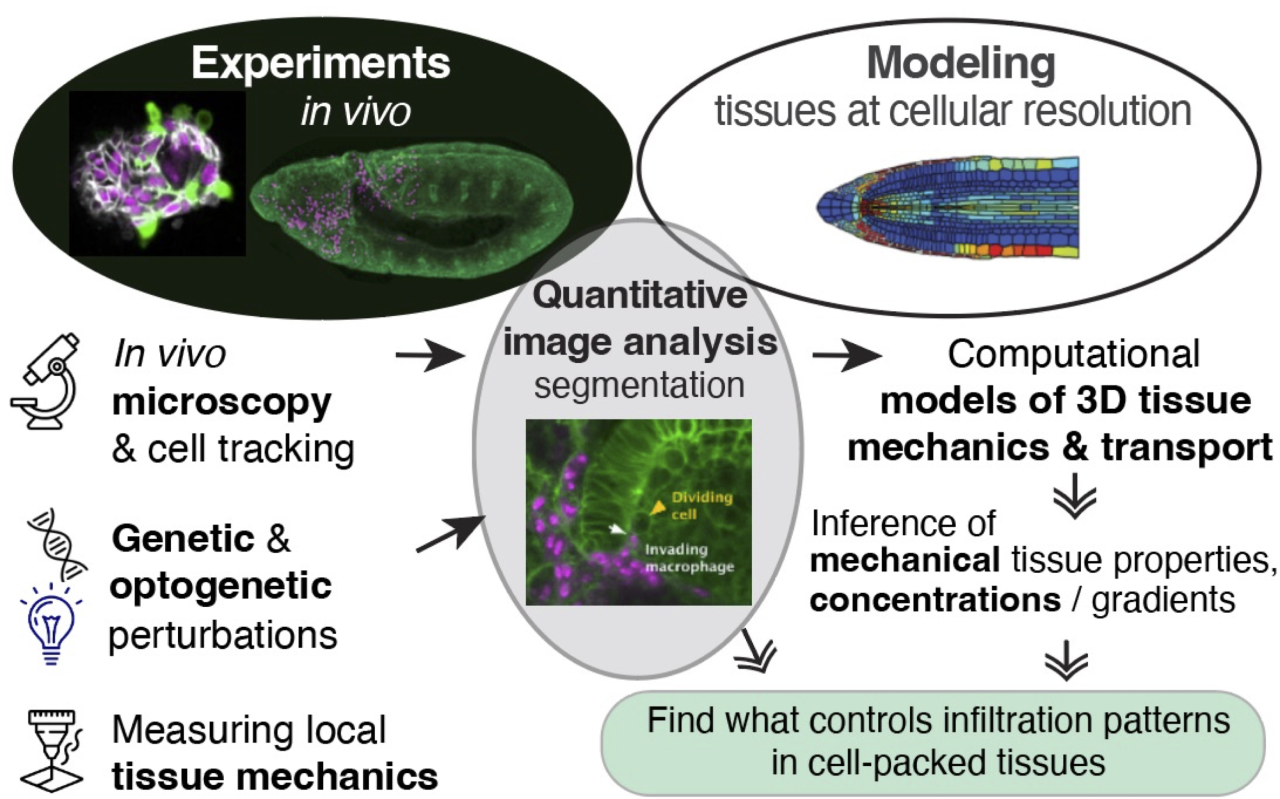
Cell migration is fundamental for the development and maintenance of multicellular organisms. Migrating cells, such as tissue-resident macrophages during embryogenesis or immune cells during inflammation, must invade and move through confined spaces, which provide both a substrate and resistance to forward movement. The strategies which cells use to overcome obstacles inside tissues are still a mystery.
Our mission is to decode the chemical and physical properties of tissue cells that control invasion. Based on our previous findings, we believe that the timing and location of invasion are heavily influenced by dynamic changes in the surrounding tissue, such as cell divisions. How do migrating cells sense these transient changes? Which signals direct their movements towards the favorable path?
To explore these questions, we harness advanced in vivo imaging techniques, genetics, optogenetics, mechanical measurements, and computational modelling, primarily using Drosophila and tissue organoids as our experimental models.
Ultimately, we strive to reveal how cell-cell interactions in a dynamic multicellular environment drive the spread of migratory cells. This knowledge could illuminate complex phenomena like morphogenesis, immune cell infiltration into tumors, cancer metastasis, and tissue aging. By expanding our understanding, we hope to pioneer new approaches to manipulate cell invasion and infiltration, paving the way for innovative disease treatments.
Figure 1.
Biography
Maria Akhmanova did her undergraduate and graduate training at Lomonosov Moscow State University, Moscow, and subsequently received her Ph.D in Biophysics for theoretical studies of molecular transport in biological tissues. For her post-doctoral research, she joined the lab of Daria Siekhaus at ISTA, Austria, and later at University of California, Los Angeles to study cellular migratory behaviors in vivo using Drosophila embryo as a model. Maria discovered that to invade confined environment of cell-dense tissues Drosophila immune cells leverage dynamic changes in surrounding cells, in particular, local detachments caused by divisions. In the same time she continued to molecular transport using computational methods. She started her lab at Memorial Sloan Kettering Cancer Center, Cell Biology Program in 2024. Research in her lab focuses on molecular and mechanobiological mechanisms of cell-on-cell migration in packed tissues such as epithelia.
Distinctions:
Austrian Science Fund (FWF) Lise Meitner fellowship 2018
Selected Publications:
Akhmanova M.*, Emtenani S., Krueger D., Gyoergy A., Guarda M., Vlasov M., Vlasov F., Akopian A., Ratheesh A., De Renzis S., Siekhaus D.* (2022): Cell division in tissues enables macrophage infiltration // Science 376 (6591), pp.394-396. https://doi.org/10.1126/science.abj0425 * Co-corresponding author
Emtenani S., Martin E.T., Gyoergy A., Bicher J., Genger J-W., Köcher T., Akhmanova M., Guarda M., Roblek M., Bergthaler A., Hurd T.R., Rangan P., Siekhaus D.E. (2022): Macrophage mitochondrial bioenergetics and tissue invasion are boosted by an Atossa‐Porthos axis in Drosophila// The EMBO Journal, e109049. https://doi.org/10.15252/embj.2021109049
Fendrych M., Akhmanova M., Merrin J., Glanc M., Hagihara S., Takahashi K., Uchida N., Torii KU., Friml J. (2018) Rapid and reversible root growth inhibition by TIR1 auxin signaling// Nature Plants, Jul;4(7):453-459. https://doi.org/10.1038/s41477-018-0190-1
Akhmanova M.A., Osidak E. O., Domogatsky S. P., Rodin S., Domogatskaya A.(2015) Physical, spatial, and molecular aspects of extracellular matrix of in vivo niches and artificial scaffolds relevant to stem cells research// Stem cell International (19):167025. https://10.1155/2015/167025