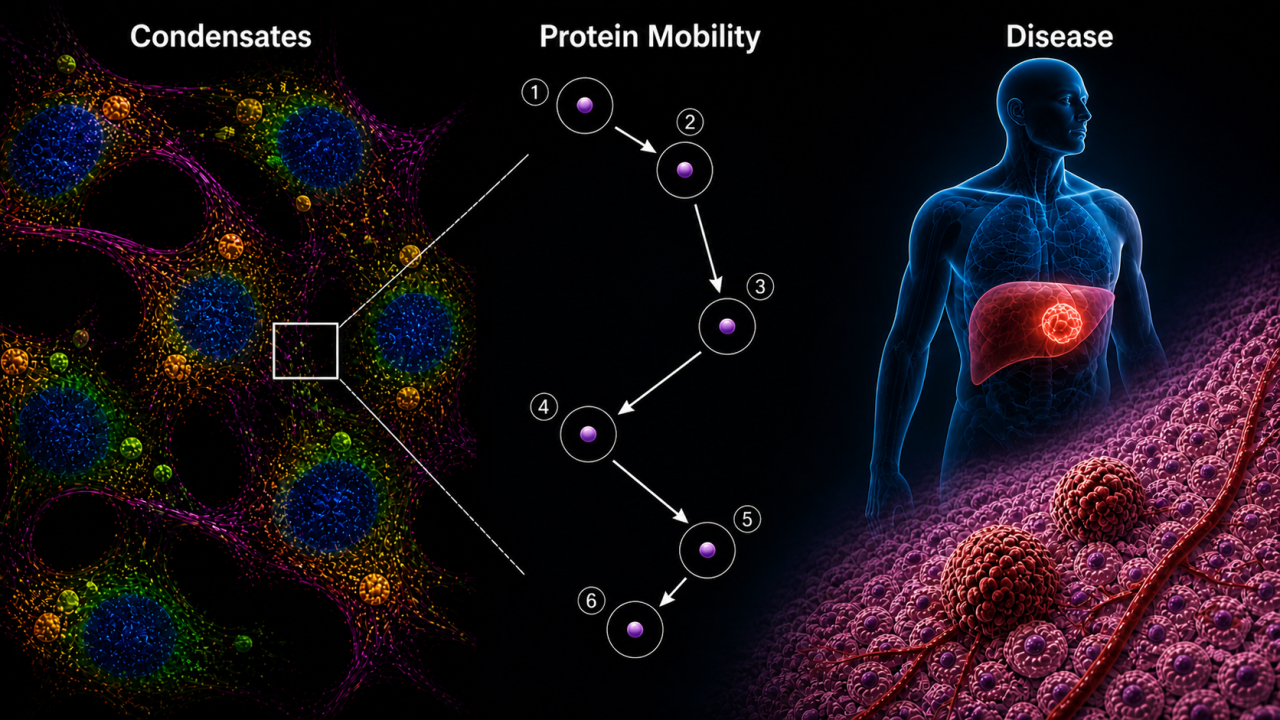
Current efforts in the laboratory are focused on i) how metabolic state rewires condensate chemistry, ii) protein mobility as a fundamental regulatory axis, iii) restoring molecular motion in disease, and iv) leveraging machine learning to define cellular physiology and disease.
The Platt Lab investigates how changes in cellular organization, including biomolecular condensates and protein mobility, shape the biology of human disease.
Our research asks how the physical organization of the cell governs biological function and how its disruption drives human disease. We study biomolecular condensates—dynamic, membraneless compartments that concentrate biomolecules—and protein mobility as critical determinants of intracellular organization. Together, condensates and protein mobility regulate how proteins encounter substrates, coordinate biochemical reactions, and maintain cellular homeostasis. Our work has defined two mechanisms linking cellular organization to disease. We defined condensate dysfunction, a pathological state in which membraneless compartments lose integrity and fail to coordinate molecular processes. We also discovered proteolethargy, a reduction in protein mobility that prevents proteins from reaching their targets and disrupts cellular function. These mechanisms help explain how common stresses such as hyperglycemia, dyslipidemia, and inflammation impair cellular organization across diverse disease contexts.
Building on these discoveries, our laboratory is defining how condensate material properties and protein mobility shape health and disease. For example, we are investigating how metabolic state reshapes the chemical environment and material properties of biomolecular condensates, thereby disrupting the biochemical functions carried out within these compartments and driving cellular dysfunction in disease. In addition, we are mapping the protein mobility landscape of the proteome and identifying regulators that shape condensate chemistry and dynamics in disease. By positioning condensate material properties and protein mobility alongside abundance, activity, and localization as core dimensions of cellular regulation, this work defines a new axis of cell biology that governs cellular function and reveals therapeutic strategies to restore cellular organization in disease.
Figure 1.
Biography
Dr. Jesse Platt is an Assistant Professor of Medicine and Cell and Developmental Biology at Weill Cornell Medicine. His laboratory asks a simple but powerful question: how do changes in the cell’s internal organization shape the biology of human disease? His work defined condensate dysfunction, in which membraneless compartments lose integrity and fail to organize biomolecules, and discovered proteolethargy, a pathological reduction in protein mobility that impairs cellular function. These discoveries suggest that common stressors disrupt cellular organization and contribute to chronic disease, motivating a broader effort to define cellular organization as a fundamental dimension of human pathology.
Distinctions:
ASCI Young Physician-Scientist Award (2026)
Harvard Catalyst KL2 Research Fellowship (2022–2024)
MGH Fund for Medical Discovery (2022–2023)
Doris Duke Fellowship (2014)
Selected Publications:
Dall’Agnese A*, Zheng MM*, Moreno S*, Platt JM*, Hoang AT, Kannan D, Dall’Agnese G, Overholt KJ, Sagi I, Hannett NM, Erb H, Corradin O, Chakraborty AK, Lee TI*, Young RA*. (2025). Proteolethargy is a pathogenic mechanism in chronic disease. Cell, 188(1), 207-221.
Klein IA, Boija A, Afeyan LK, Hawken SW, Fan M, Dall'Agnese A, Oksuz O, Henninger JE, Shrinivas K, Sabari BR, Sagi I, Clark VE, Platt JM, Kar M, McCall PM, Zamudio AV, Manteiga JC, Coffey EL, Li CH, Hannett NM, Guo YE, Decker TM, Lee TI, Zhang T, Weng JK, Taatjes DJ, Chakraborty A, Sharp PA, Chang YT, Hyman AA, Gray NS, Young RA. (2020). Partitioning of cancer therapeutics in nuclear condensates. Science. 368(6497):1386-92.
Li CH, Coffey EL, Dall’Agnese A, Hannett NM, Tang X, Henninger JE, Platt JM, Oksuz O, Zamudio AV, Afeyan LK, Schuijers J, Liu XS, Markoulaki S, Lungjangwa T, LeRoy G, Svoboda DS, Wogram E, Lee TI, Jaenisch R, Young RA. (2020). MeCP2 links heterochromatin condensates and neurodevelopmental disease. Nature. 1-8.