To discover and model quantitatively the structure-dynamics-function relationships that determine the involvement of an individual cell component (such as a molecular motor in the membrane) in cell physiological mechanisms and how it is modulated by its environment, disease factors, and drugs. Use the quantitative understanding to understand and simulate disease mechanisms and design therapeutics and biomimetic devices.
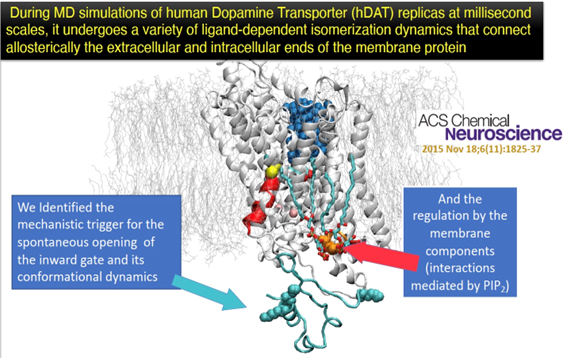
Membrane biophysics and how it affects the Functional mechanisms of neurotransmitter transporters: We developed an unprecedented understanding of the mechanisms that drive the functions of neurotransmitter transporters in neuronal processes and mechanisms of drugs of abuse (see 1a in List of Selected Publications)
Allostery and the mechanisms of molecular machines at the membrane. Triggering and modulation of functional mechanisms of many biomolecular systems involves mechanisms that connect distal regions of the molecules, along “allosteric pathways”. Using novel analytical and numerical formulations we identify structural microdomains that act as
Figure: (i)-allosteric communication channels for long-distance information sharing between functional sites, and (ii)-as allosteric coordinators that organize dynamics within functional sites. We pioneered this level of inquiry that serves now to informs about mechanism, function under diverse conditions, repair of dysfunctional mutated systems, substitution, and repurposing of cell components of molecular machines such as GPCRs, TMEM16 scramblases, and transporters of various solutes (See 2a; 2b)
Development and implementation of novel methods for analysis of biomolecular mechanisms: We are continuously developing new approaches based on AI, ML, and molecular physics for analysis, interpretation, and quantification of results from the experimental and computational simulation assays of biomolecular function (See 3a; 3b in Selected Publications).
Since 2020 an additional area of research is the study of the molecular mechanisms of the SARS-CoV-2 to be leveraged for the design of antiviral therapy. (See 4a;4b;4c in publications)
Biography
Weinstein Received his BSc degree in Chemistry, MSc in Quantum Chemistry, and DSc in Theoretical Physical Chemistry from the Technion, Israel Institute of Technology. His postdoctoral training was at Johns Hopkins with Robert G. Parr, after which he started his independent career as an Assistant Professor of Pharmacology at Mount Sinai School of Medicine (MSSM) in NYC, rising through the ranks to Full Professor. In 1985 he became the Dr. Harold and Golden Lamport Professor and Chairman of the Department of Physiology and Biophysics at MSSM. He was recruited in 2002 to Weill Cornell as the Maxwell Upson Professor, Chair of the Department of Physiology and Biophysics, the Founding Director of the Institute for Computational Biomedicine (ICB), and Tri-Institutional Professor. In 2021 he stepped down as department chair and maintains his other appointments and activities.