The Alexander Gitlin Lab studies how inflammatory cell signaling controls the nature and magnitude of inflammation under physiological and disease conditions.
Innate immune cells are tasked with integrating diverse molecular signals from both host and pathogen to produce appropriately commensurate inflammatory responses. Whereas insufficient inflammatory responses can lead to immunodeficiency, overexuberant inflammation can cause devastating collateral tissue damage.
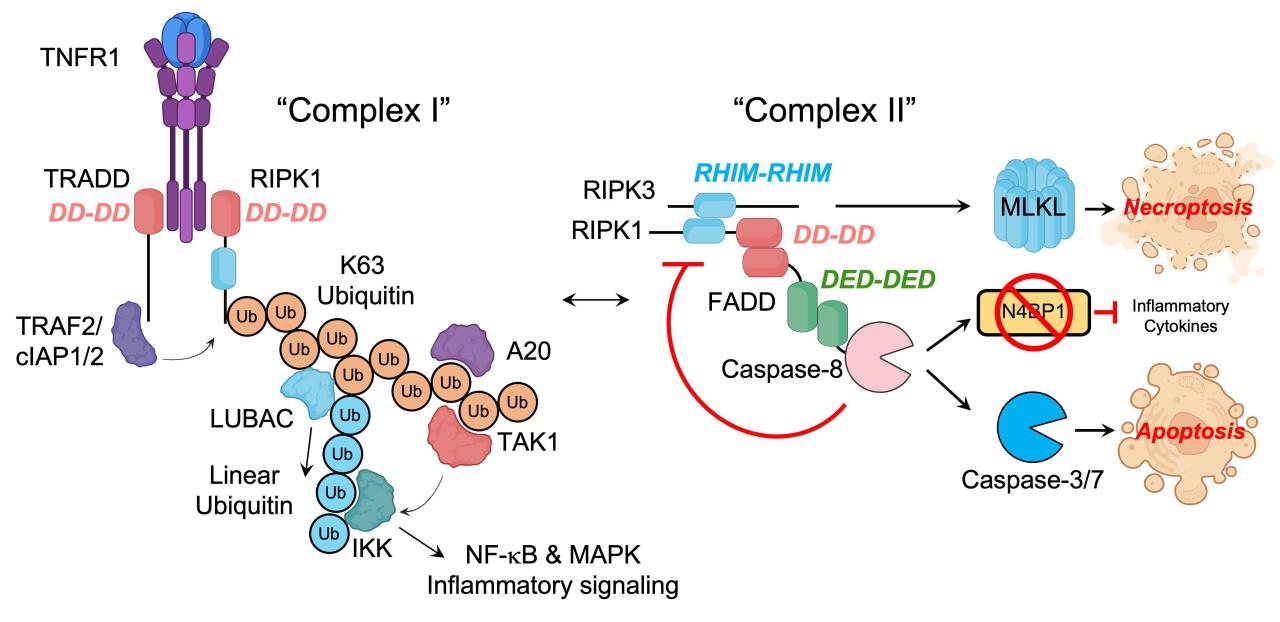
We study a set of genes that control the balance between cellular signaling and death and whose deficiencies cause a wide spectrum of severe genetic immune diseases in humans. Focusing on this interconnected network of genes, we use genome editing in primary immune cells, in vivo models, biochemistry, proteomics, advanced imaging techniques, and genomic screens to decipher molecular and cellular pathways that govern inflammation and innate immunity.
Figure 1
Biography
Alex Gitlin earned his undergraduate degree in Chemistry and Physics from Harvard University in 2009. He then joined the Tri-Institutional M.D.-Ph.D. program, where he did his graduate work in Michel Nussenzweig’s laboratory at Rockefeller University. In 2017, Alex joined Stanford for his residency in Clinical Pathology and pursued postdoctoral training as a Visiting Scientist in Vishva Dixit’s laboratory at Genentech, Inc. Alex was appointed as an Assistant Member in the Immunology Program of the Sloan Kettering Institute in 2022.
Distinctions:
Josie Robertson Investigator Award
NIH Director’s DP5 Early Independence Award
Burroughs Wellcome Fund: Career Award for Medical Scientists
NIAID K08 Mentored Clinical Scientist Research Career Development Award
Harold M. Weintraub Graduate Student Award
Publication Highlights:
Narendra VK, Das T, Wierciszewski LJ, Londoner RJ, Morrison JK, Martindale P, Devine T, Chen K, Trombetta M, Kanno Y, Casiano AE, de Stanchina E, Lareau CA, Lowe SW, Gitlin AD*. *Corresponding author. Independent mechanisms of inflammation and myeloid bias in VEXAS syndrome. Nature. 2025 Nov 3. doi: 10.1038/s41586-025-09815-0. Online ahead of print.
Gitlin AD, Maltzman A, Kanno Y, Heger K, Reja R, Schubert AF, Wierciszewski LJ, Pantua H, Kapadia SB, Harris SF, Webster JD, Newton K, Dixit VM. N4BP1 coordinates ubiquitin-dependent crosstalk within the IκB kinase family to limit Toll-like receptor signaling and inflammation. Immunity. 2024 May 14;57(5):973-986.e7. doi: 10.1016/j.immuni.2024.04.004. Epub 2024 May 1. PMID: 38697117; PMCID: PMC11096006.
Newton K, Gitlin AD. Deubiquitinases in cell death and inflammation. Biochem J. 2022 May 27;479(10):1103-1119. doi: 10.1042/BCJ20210735. PMID: 35608338; PMCID: PMC9162465.
Gitlin AD, Heger K, Schubert AF, Reja R, Yan D, Pham VC, Suto E, Zhang J, Kwon YC, Freund EC, Kang J, Pham A, Caothien R, Bacarro N, Hinkle T, Xu M, McKenzie BS, Haley B, Lee WP, Lill JR, Roose-Girma M, Dohse M, Webster JD, Newton K, Dixit VM. Integration of innate immune signaling by caspase-8 cleavage of N4BP1. Nature. 2020 Nov;587(7833):275-280. doi: 10.1038/s41586-020-2796-5. Epub 2020 Sep 24. PMID: 32971525.