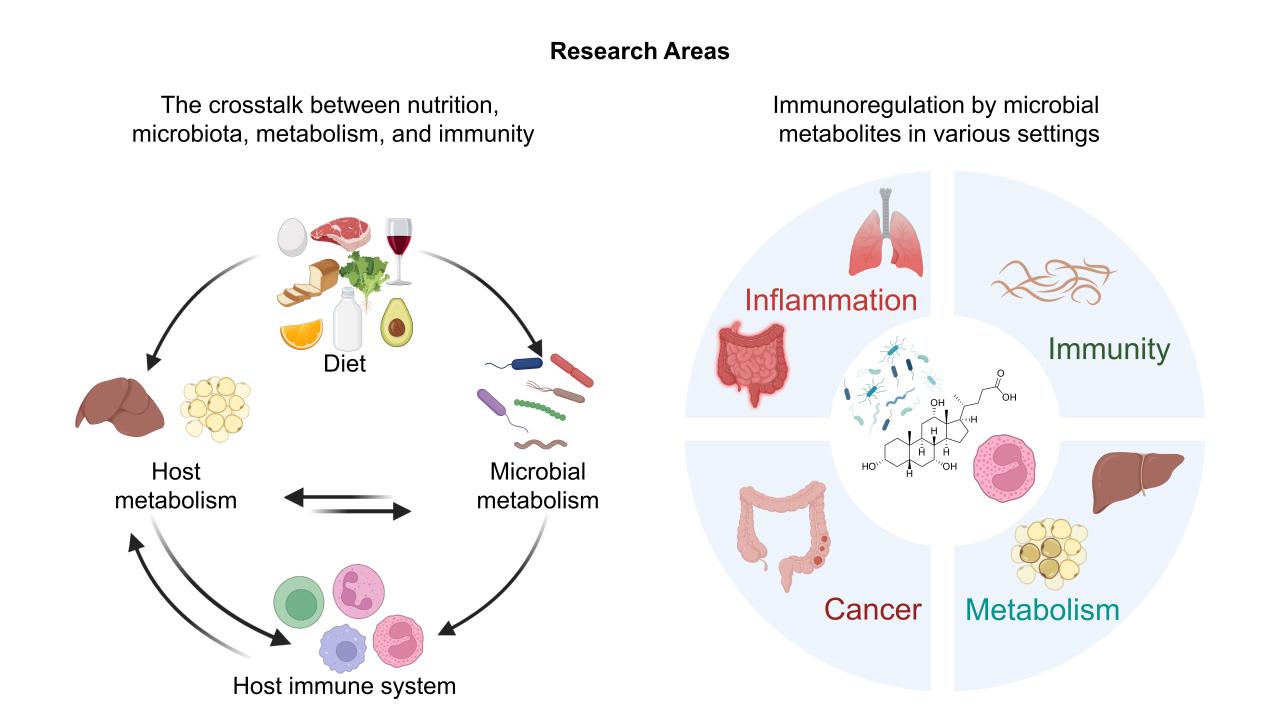
Defining the impact of diet and microbial metabolites on i) intestinal inflammation, tumorigenesis, and anti-tumor immunity; and ii) immune-metabolic interactions in obesity and liver disease.
The Arifuzzaman Lab seeks to uncover the cellular and molecular mechanisms by which diet and microbiota regulate the immune system in various settings including inflammatory and metabolic diseases, infection, and cancer.
Diet plays a pivotal role in shaping not only our own metabolism but also that of our gut microbiota. The nutritional status of the host can dramatically alter both the composition and metabolic activity of intestinal microbiota, which, in turn, profoundly effects host immune and metabolic outcomes. The gut microbiota produce a vast array of bioactive small-molecule metabolites that regulate diverse physiological processes in the host. However, the majority of these microbial metabolites, their regulation by diet, and their effects on host immunity and metabolism remain largely unexplored.
To address these gaps, we have adopted a cutting-edge metabolomics-based approach that integrates targeted and untargeted metabolomics with bacterial genetics and host transcriptomics. This comprehensive strategy enables us to pinpoint key microbial metabolites, identify the microbial genes responsible for their production, and uncover the host receptors that mediate their effects on host physiology. Through this lens, we seek to unravel how specific nutrients influence the gut microbiota and how these diet-microbiota interactions shape host immune and metabolic responses. Moreover, we are investigating the role of interconnected systems, such as the nervous system, in these regulatory networks.
Our lab employs flow cytometry and microscopy to explore the communications between various immune cells, such as eosinophils and macrophages, and non-immune cells like epithelial cells, stromal cells, and neurons. We leverage metagenomic analyses, single-cell and spatial transcriptomics, and high-resolution mass spectrometry-based metabolomics to decode the immunoregulatory functions of microbiota-derived metabolites and their host receptors. The ultimate aim of our research is to uncover the molecular mechanisms through which environmental factors, including diet, shape immune responses. These insights will pave the way for designing novel interventions and therapeutic strategies to prevent and treat disease.
Figure 1.
Biography
Dr. Arifuzzaman earned his Ph.D. in Molecular Genetics and Microbiology from Duke University, where he studied innate immune defense mechanisms of mast cells and macrophages in Dr. Soman Abraham’s lab. He pursued his postdoctoral training with Dr. David Artis at Weill Cornell, focusing on the regulation of eosinophils by gut microbiota. During this time, he developed his current research program, which centers on understanding the role of diet and microbiota in mucosal immunity and beyond. In recognition of his scientific achievements as a postdoc, Dr. Arifuzzaman was awarded the 2024 Tri-Institutional Breakout Award for Junior Investigators. Dr. Arifuzzaman joined as tenure-track faculty member in the Division of Gastroenterology and Hepatology at the Department of Medicine, where he is leading the cutting-edge research focused on defining the intricate tripartite relationships between nutrition, microbiota, and immunity in the contexts of infection, inflammatory and metabolic diseases, and cancer.
Distinctions:
International Cytokine and Interferon Society-Regeneron New Investigator Award for Excellence in Cytokine and Interferon Research
NOSTER & Science Microbiome Prize Finalist
American Association of Immunologists ASPIRE Award for Outstanding Early Career Achievement in Immunology
Tri-institutional Breakout Prize for Junior Investigators
NIH Pathway to Independence Award; Crohn’s and Colitis Foundation Postdoctoral Research Fellowship Award